Other Sights
The House and Mausoleum of Don Šime Ljubić
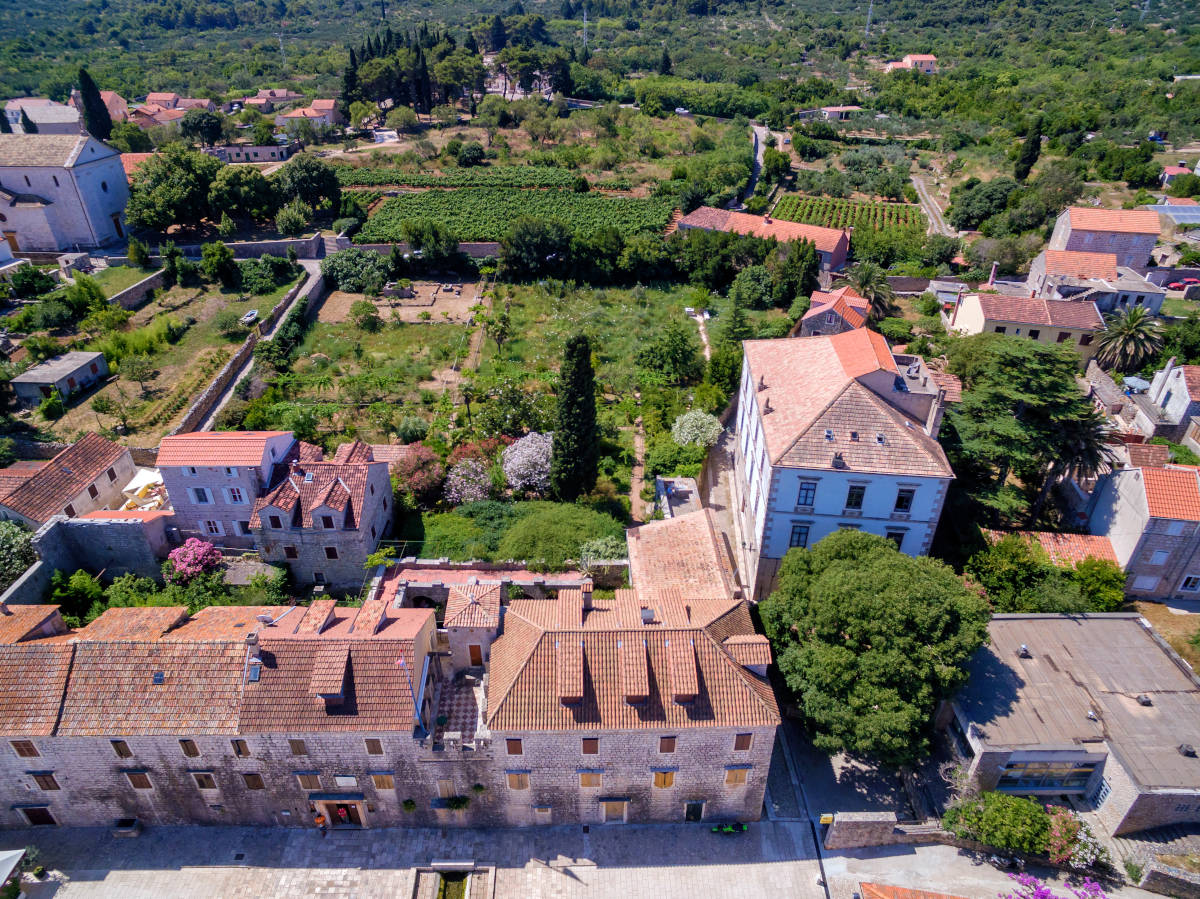
Don Šime Ljubić (1822 -1896), renowned archaeologist, historian and one of the founders of the Croatian Academy of Sciences and Arts, built this historicist villa in 1887 according to the blueprints of Srećko Jacomini, a noted Zagreb architect of his time. The villa is decorated with terracotta sculptures, allegories of muses and ancient deities, with Apollo being the most prominent one. Šime Ljubić was buried in the mausoleum on the west side of the house, with permission from then Austro-Hungarian emperor Francis Joseph I.
Windmill – Mill
The windmill – flour mill, dates back to the end of the 19th century, when a large fleet of Stari Grad’s ancient sailing ships was carrying wheat to the island from the Black Sea and eastern Mediterranean.
The Birth House of Painter Juraj Plančić
This 19th century house is where renowned Croatian painter Juraj Plančić was born in 1899. His talent led him away from his hometown, originally to Zagreb and then to Paris where, in four years leading up to his untimely death in 1930, he painted some of the most beautiful paintings of Croatian modern art.
The Srinjo kola
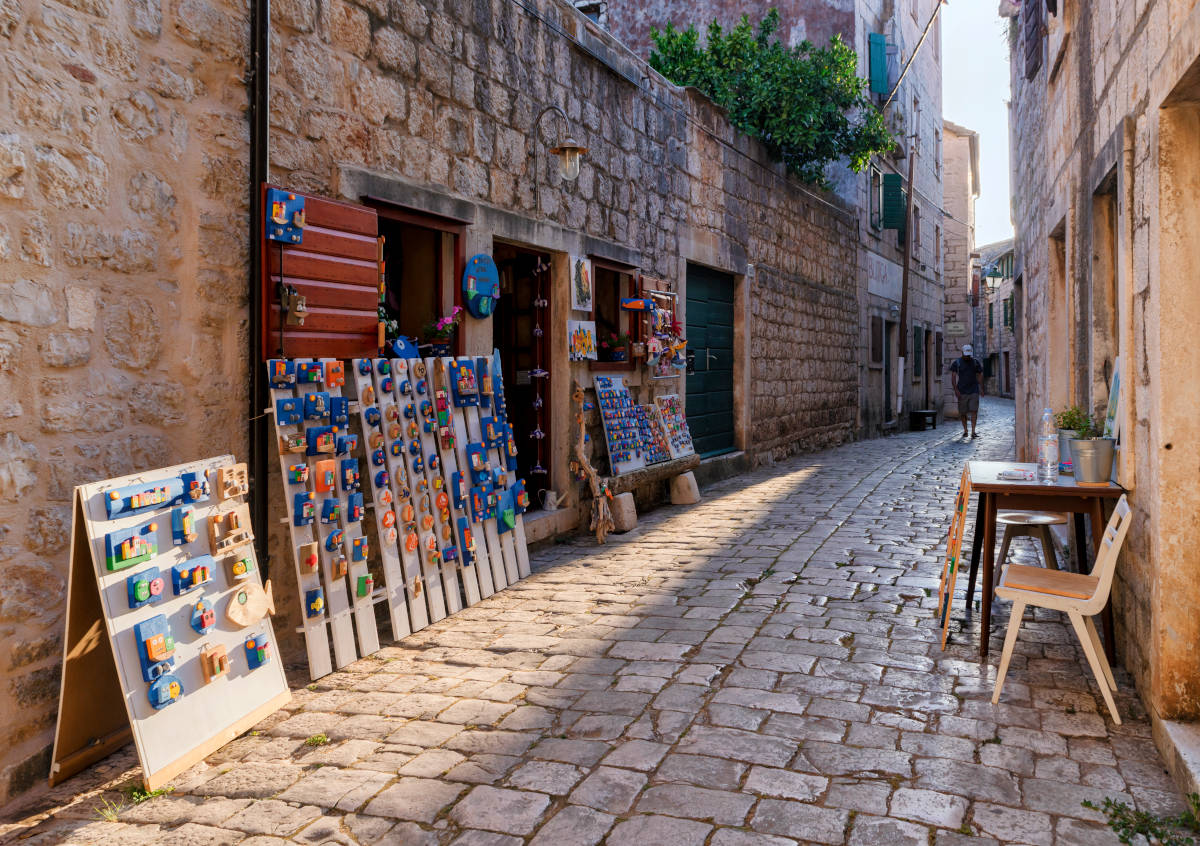
In the island dialect the phrase srinjo kola means “the Middle Street”. It was once the main street and the trading centre of Stari Grad. The oldest house on the street is from the early Gothic period (14th/15th century) and is located opposite the Ljubić Gallery. The house of the pharmacist Gariboldi from Milan (16th century) is in the centre of the street, and is easily recognizable by its crest featuring four stars above a fort. Underneath one part of the Middle Street, lie floor mosaics of a Roman urban villa from the 2nd century, which can be seen in the Moira Gallery.
The Duolnjo kola
In the island dialect the phrase duolnjo kola means “the Lower Street”. It was formed in the 15th/16th century. It’s believed that this street, now parallel to the shore, was the the border of the seashore in Antiquity. The street’s Café Antica is located in the house with a wall chapel carrying a Latin inscription: Lord Jesus Christ, son of the living God, who hung on the cross and spilled his blood for human nature, have mercy on your people 1566.
Juraj Škarpa Square
This square is a small space among the tightly packed houses of the Medieval part of Šiberija quarter. Šiberija got its name from the word Siberia due to the coldness of that area. The square holds a statue by Stari Grad sculptor Juraj Škarpa – Ranjena from 1921. The sculptor’s birth house is located opposite the statue, and adorning it is a small stone inscription from 1587: Oh, glorious cross, be our hope, God and man expired on thee.
Park Vorba
Up until the mid-19th century, the park was actually a shallow, marsh shoal with salt pans. After this area was covered up, the park was completed in 1892 according to the ideas of Stari Grad’s Petar Biankini (1856-1928), one of the first horticulture experts in Croatia. The park was named after a spring well at the southeast entrance mentioned in the Hvar statute in 1331 as the spring called Willow (fons vocata Varba). The channels around the park are the remnants of the streams which flowed into the shallow end of the Stari Grad Bay, but they also shoulder the overflowing sea from the tides to which Stari Grad is often exposed.
The Gelineo Bervaldi Houses Compound
The Bervaldi family is a wealthy Stari Grad family mentioned for the first time during the late 16th century. They were owners of large estates (in the 18th century some of them were even in Treviso, Italy), as well as houses in Stari Grad, Hvar and Vis and were also the commissioners of church altars (the main altar in St. Stephen’s Church was commissioned from Pavle Tremignon in Venice in 1698 by Antun Bervaldi himself). At the end of the 18th century, the Bervaldis were linked to the Galineos, a family of traders and ship owners.
The Gelineo – Bervaldi house stands out with its interior design and comfort since it housed Hvar bishops during their visits to Stari Grad.
The Pharia Town Wall – the Cyclops Wall
The town wall of the late Antiquity Pharia was built during the 4th century using blocks from the walls of the Greek Pharos. Its remains in the length of 11 meters can be found in the tavern of house Gramotorov. It got the name Cyclops Wall in the 19th century when observers, fascinated by the size of the stone blocks, believed that it could only have been built by giants – the cyclops.
The Holiday House of Hanibal Lucić – Diocese
This countryside estate compound with its inner courtyard and garden was built at the beginning of the 14th century by Croatian Renaissance poet and Hvar nobleman Hanibal Lucić (1485 – 1553), as the administrative headquarters of his estates located in the Stari Grad Plain. The name Diocese is an older toponym which this compound inherited.
It endured major reconstruction in the 19th and 20th century. Most preserved is the courtyard, with its terrace on consoles, and the well crown in the center of the courtyard.
The Molo selo
Molo selo, or Villeta, is a suburb of Stari Grad built in the 17th century by new inhabitants which arrived from the mainland during the Venetian – Turkish war for Crete, the Kandyan War (1645–1669).
It was separated from Stari Grad for a long time by a marsh shoal, today’s Park Vorba. Residential houses are positioned around communal courtyards with auxiliary cottages for donkeys and goats – the unavoidable companions of the labourers residing there.
Cemetery
Up until the beginning of the 19th century, the dead were buried in and around churches. During the French Napoleon administration in Dalmatia (1806 – 1813) this custom was banned by decree, for hygienic reasons, and the people of Stari Grad began to be buried in the new cemetery.
The oldest part of the cemetery was completed in mid-19th century. The children and the nameless were buried in the first part of the cemetery (without tombs), while the second elevated part, with a small church from 1849, harmoniously reconciles the graves of prominent Stari Grad families and modest, common tombs of brotherhoods and charitable cooperatives.